
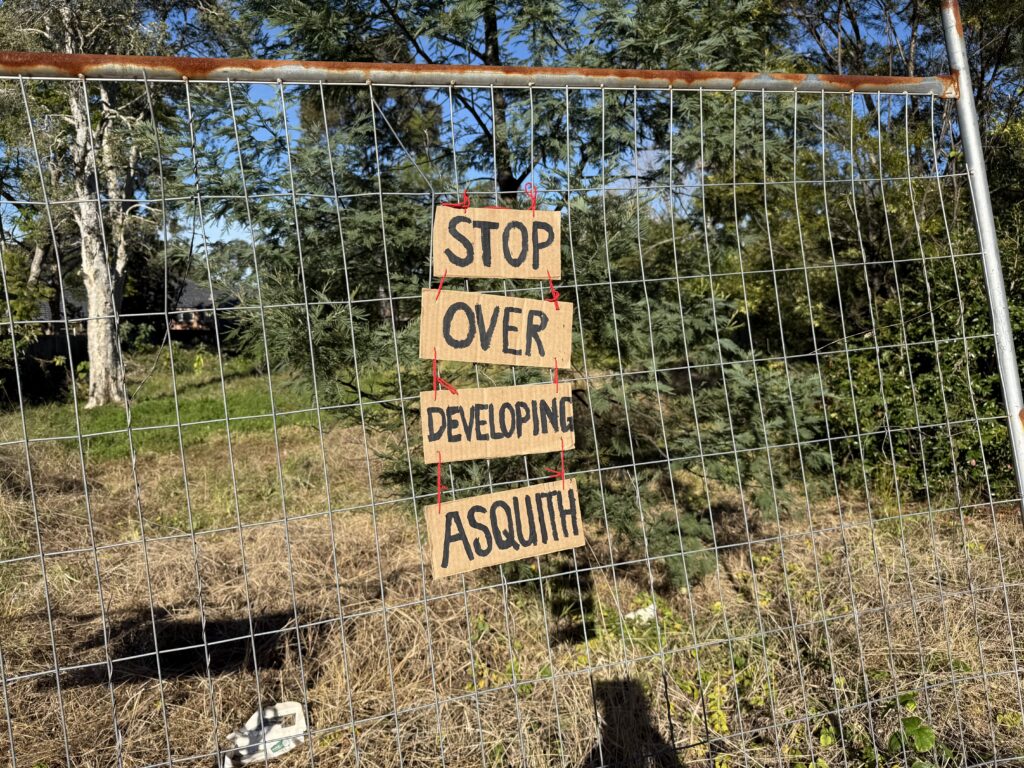
Over 100 residents gathered on the footpath of 4 – 6 Baldwin Avenue, Asquith, on Tuesday 14 July 2026, for a tense Land and Environment Court (LEC) conciliation meeting. Community members turned out in force to face developers, voicing overwhelming opposition to a proposed nine-storey residential flat building that many warn will permanently shatter the suburb’s local character.
The controversial Development Application (DA/110/2026), lodged by Wellsfortune Property Group, seeks consent to demolish two existing single-storey homes and construct a 28.95-metre-high apartment tower featuring 33 units (including six affordable housing units) and three levels of basement parking.
Hornsby Shire Council formally refused the application, refusing to bow to the developer’s scale. Following the refusal, the developer lodged a Class 1 appeal with the NSW Land and Environment Court, dragging the battle out onto the street and into the judicial system. During the on-site inspection, local residents made it clear that their outrage stems not from a refusal to accept growth, but from a complete disregard for sound urban planning.

Key Takeaways
- Community Stand: Over 100 Asquith residents gathered for a Land and Environment Court (LEC) conciliation meeting to protest a proposed nine-storey high-rise at 4–6 Baldwin Avenue.
- Development Details: The DA (DA/110/2026) by Wellsfortune Property Group seeks to replace two single-storey homes with a 28.95-metre tower featuring 33 units (including six affordable housing units) and three levels of basement parking.
- Council Refusal & Appeal: Hornsby Shire Council formally refused the application, leading the developer to file a Class 1 appeal with the NSW LEC.
- Formal Objections: Council submitted 21 contentions to the court—supported by over 150 community objections—citing severe concerns regarding height, bulk, loss of 19 mature trees, traffic, bushfire safety, and heritage impacts.
- Existing Approval: Residents emphasized that the site already holds an approved DA for 11 townhouses, proving that sensible density can be delivered without compromising local character.
Local resident Steve Thompson, speaking directly to the presiding Commissioner, highlighted that the site already has an approved consent for 11 townhouses – proof that increased housing density can be achieved while respecting local context.
“My objection isn’t to development. It’s to this proposal,” Mr Thompson stated. “Instead of providing a gradual transition in scale, it jumps immediately from detached homes and two-storey townhouses to a nine-storey apartment building. Planning is about transitions, not contrasts. This proposal doesn’t transition into the neighbourhood – it collides with it.”
Council has backed community concerns with a formidable legal defence, submitting 21 comprehensive contentions to the court. Among Council’s key objections are:
- Incompatible Height & Bulk: The site sits at one of Asquith’s highest elevations. A 28.95m structure abruptly contrasts with the adjacent two-storey-plus-attic townhouses and neighbouring low-density R2 residential zones.
- Traffic & Bushfire Safety: Increased vehicle movements risk gridlocking narrow access arteries like Sherbrook Road, raising serious safety concerns for bushfire evacuation and nearby school precincts.
- Loss of Canopy & Deep Soil: The development proposes the destruction of 19 mature local trees while failing to provide adequate deep soil or canopy replanting required under planning guides.
- Heritage & Design Flaws: The tower directly impacts the visual catchment of nearby heritage-listed items – including the Federation cottage on Sherbrook Road – while creating severe overshadowing, overlooking, and internal solar access deficits.
More than 150 formal community objections have been submitted against the project.
When reached for comment, a spokesperson for Hornsby Shire Council confirmed it shared the community’s substantive concerns.
The spokesperson noted that the DA utilises additional height provisions under Chapters 2 and 6 of the State Environmental Planning Policy (Housing), which override Council’s local planning controls in exchange for including affordable housing units.
“Council has consistently advocated that State planning controls should not override local Council planning instruments. However, this remains the case and Council is required to assess all Development Applications it receives within the legislated planning framework,” the spokesperson said.
“Council will continue to assess any application against the applicable legislation on its merits.”
Council also confirmed that the DA does not require referral to Transport for NSW (TfNSW) under state policy, as it does not meet traffic-generating thresholds or sit on a classified state road – leaving traffic assessment solely as an issue for Council.
While the community and local council stand united on the frontlines, representatives higher up the political ladder appear noticeably absent.
The Post reached out to both Federal Member for Berowra Julian Leeser and State Member for Hornsby James Wallace, asking for their position on the Baldwin Avenue DA and how such high-density developments impact the local Asquith community.
At the time of publishing The Post has not received any response from either James Wallace, or Julian Leeser.
As the Land and Environment Court proceedings continue, the message from Asquith remains resolute: development must respect the community it joins, rather than dominate it.