















Key Takeaways
- The Statistic: Australian Institute of Family Studies (AIFS) data shows that 14% (1 in 7) of older adolescents experience suicidal ideation, plans, or attempts.
- The Protective Shield: A strong, sustained sense of school belonging between ages 16–17 drops downstream mental health risks by 10% in the following years.
- Active Intervention: Vulnerable students who participate proactively in school activities show an 18% lower likelihood of experiencing suicidal ideation.
Anastasia Naicker was outgoing, happy, and confident growing up in Queensland, a twin with a ready-made best friend and a primary school she loved. Then came Year 9, moving interstate comes with its usual challenges for a Year 9 student, but nobody expected this for 15 year old Anastasia.
Anastasia’s old friend group had made a group chat; her phone lit up with messages of names, slogans, and cruelty. She opened a social media app to find a photo from their last day together, with her face photoshopped out. The caption read: “Life’s so much better without you.”
“That broke me,” she says. “Tore me into like a million pieces.”
The cyberbullying continued daily. Anastasia withdrew completely, refusing to go to school, refusing to make new friends, terrified it would happen again. “I lost trust and confidence in everyone, including my family and myself.”
Stories such as Anastasia’s are becoming less unusual. As new research from the Australian Institute of Family Studies (AIFS) shows, around 1 in 7 (14%) young Australians aged 18-19 report suicidal ideation, plans, or attempts. Within the same research‚ drawing on 20 years of data from 10,000 children and families, gave parents and teachers insight into what will mitigate this.
The answer is: a strong sense of school belonging, because when belonging is felt, there is a link between the likelihood of suicidal thoughts and behaviours, lowering by 10% during the ages of 16-17 in the following years. For young people who are already at risk, active participation in school life is associated with an 18% lower likelihood of suicidal ideation.
The message is unambiguous: Schools that make students feel safe, included, and connected are schools that save lives.
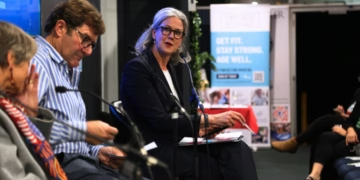
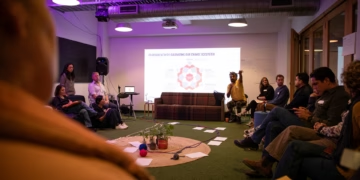
This is exactly the ground the Australian Education Research Organisation (AERO) has been working on. In a webinar on fostering safe and supportive learning environments, AERO’s Sarah Richardson and specialist Cate Whiting explored the practical evidence behind classroom management resources designed to help teachers and school leaders build exactly that kind of environment‚ one where students feel settled, respected, and genuinely part of something.
Natalie Polak, Assistant Principal at Dubbo South Public School, shared the real-world difference those approaches made in her school.
Her school of 566 students, 33% of whom are Aboriginal, has weathered COVID lockdowns, a devastating school fire, and a chronic teacher shortage. “All of these events hindered relationships, routines, and reliability,” she says, the very foundation of a school where students should feel safe. AERO’s resources are freely available and designed for teachers and leaders at every career stage, focusing on building positive relationships, establishing clear routines, and explicitly teaching expectations. These aren’t just tools for good education. In the context of the AIFS findings, they are tools for prevention.
Since the implementation, “Natalie says. “We’re no longer surviving; now we’re able to thrive.” The focus from research to the classroom to lived experience is clear: when schools get this right, young people like Anastasia Naicker have a chance to stay connected rather than disappear.
For Anastasia, connection eventually came through Dolly’s Dream ‚ an organisation supporting young people affected by bullying. “It’s like a storm,” she says now. “It passes. Life is so much better on the other side.”
She is now 23, studying nursing, and will graduate alongside her mother at the end of the year. The research, the educators, and Anastasia herself continue to say the same thing: belonging isn’t a soft goal. It’s the work.
If you or someone you know needs support, help is available.
You are not alone. Please reach out to one of the following free, confidential 24/7 Australian support services:
- Lifeline: 13 11 14 (or text 0477 13 11 14)
- Beyond Blue: 1300 22 4636
- Suicide Call Back Service: 1300 659 467
- Kids Helpline (for ages 5–25): 1800 55 1800
If you are in immediate danger, please call Triple Zero (000) or go to your nearest hospital emergency department.


